Growing Deep Usage of Claude
How to grow deep Claude usage among existing active users. A staged product system covering guided promotion, frictionless Projects with portable memory, and parallel or collaborative Agents. Mockups follow the spec.
I'm a power user of Claude, and this PRD came out of my own experience. Working across the desktop app's tabs, claude.ai, and Claude Code, I kept losing track of what memory each surface had about what I was working on. That gap is what powered the product and infrastructure thinking below.
1. Overview
Product challenge: how to grow deep Claude usage among existing active users.
This applies to both Claude Growth / Monetization and API Growth. Depth of use is the same product behavior viewed from two angles. For Claude Growth it shows up as retention and tier upgrade. For API Growth it shows up as pull-through, since users who ship non-trivial work on consumer Claude tend to bring Anthropic into their company's stack.
Positioning below is a working hypothesis. Validation research is needed before committing to build. Design mocks carry specification-level detail.
2. Solution hypothesis
Two product behaviors drive depth of use:
- Projects that are frictionless to open, use, and maintain, with memory that learns about the user, their work, and each project across sessions.
- Agents that run in parallel (one user starting several independent streams of work) or collaborate (role-based agents working a shared problem).
There is an opportunity to shape UI, UX, and underlying infra so more users reach that level of depth, turning the features themselves into the growth engine.
3. Goals and metrics
North star: DAU of Projects and parallel / collaborative Agent runs among active users. Inputs that move it: first-time Project use, time-to-first parallel Agent run, time-to-first collaborative Agent run, retention of those behaviors week over week.
Signups are not the growth metric that matters here. The category funnel is saturating. Depth of use is what compounds inside the active base.
Impact is wide. Direct growth picks up retention lift and tier upgrade from users touching Projects and parallel or collaborative Agents. API growth picks up a less obvious but arguably more valuable path: Pro users who ship meaningful work in-product become the beachhead for Anthropic inside their company's API account. Deep consumer behavior is an API-growth lever, not only a consumer-growth lever.
4. Users
Segmentation of the active Pro base:
- Adventurous knowledge workers running parallel workstreams in Chat. Daily use, several threads open, context rebuilt every morning.
- Novices still in activation. New to AI tools, not yet habituated, working to form a daily use pattern.
- Power specialists at depth. Have already found the part of the product that works for them and settled into it.
- Builder-operators and developers. Already working beyond Chat via API and Code.
Focus: adventurous knowledge workers. Largest segment of the active base and the one whose current behavior already points at Projects and multi-agent workflows. Depth-of-use features should convert them faster than any other segment and move the north star the most per unit of build effort.
The other segments are out of scope for this PRD, for specific reasons:
- Novices need activation solutions (onboarding quality, first-session value, habit formation). Different build, different PRD, different metric. Worth tackling in parallel, not here.
- Power specialists are already retained and already deep in one part of the product. Their behavior is unlikely to shift without a change to what they already rely on, and upside is capped.
- Builder-operators and developers are served by the API roadmap directly. They do not need consumer-surface features to find depth.
Persona: Priya, BD lead at a 200-person SaaS company. Pro subscriber. Runs five Chat sessions a day across three deals, a partnership push, and a hiring loop. Tried Projects once, did not see the value, bounced. Has not opened Code. She measures success by emails sent.
5. Opportunities
Three opportunities to grow depth of use through product-led features:
- Make the path to advanced use visible. Surface the next level of the product in the moment a user's behavior calls for it: promote a long, multi-reference Chat into a Project; suggest a parallel Agent run; recommend a collaborative Agent team.
- Make Projects and memory a first-class pull. Projects should be as low-cost to open and live in as a Chat, and memory should be a consistent layer that learns about the user, their work, and each project across sessions and surfaces (Chat, Desktop, Code).
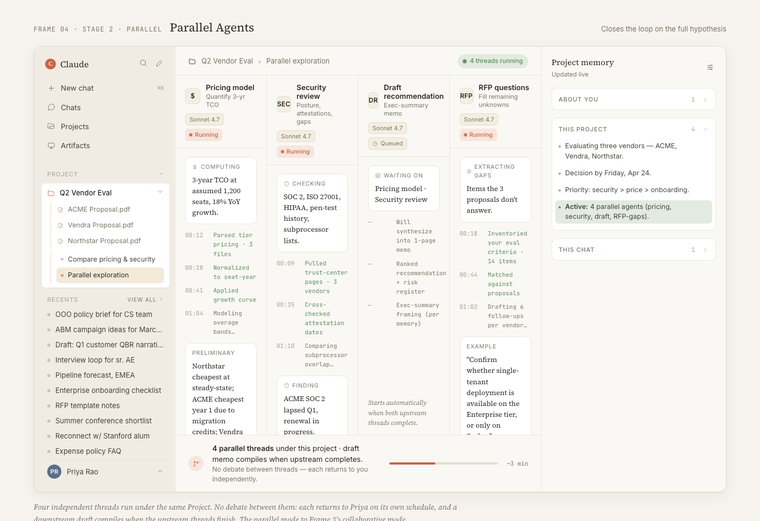
- Bring parallel and collaborative Agents onto the main path. Support one user running several independent streams at once (a website feature, help docs, a finance model, doc organization, an image-to-menu task) and templated role-based teams (PM, designer, engineer) working a shared problem.
6. Three ideas
| What it is | Layer | Cost | |
|---|---|---|---|
| A. Guided promotion | Claude reads signals (length, breadth, file references, planning language) and surfaces the next level at the moment it applies: promote this chat to a Project, spawn parallel Agents, or open a collaborative Agent team. | UX | Low |
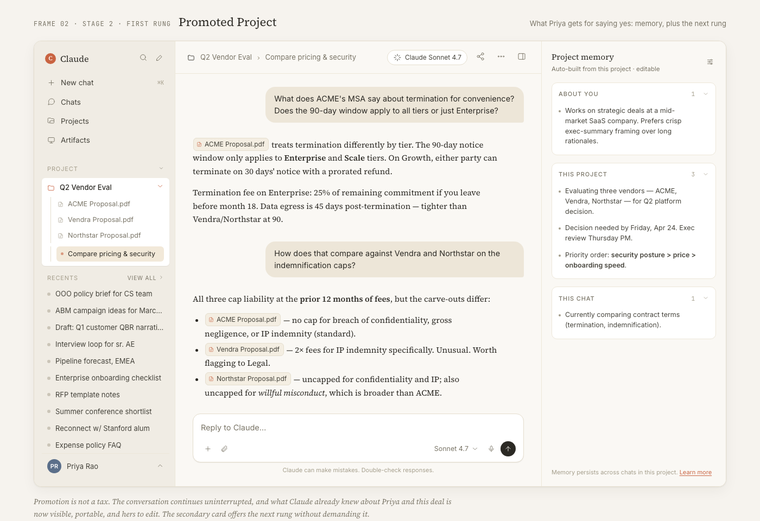
| B. Frictionless Projects with portable memory | Redesign Project entry and maintenance so it costs no more than staying in Chat. Memory is tiered (about-you, project, chat), auto-built, reviewable, editable, and consistent across Chat, Desktop, and Code. | Infra + UX | Medium |
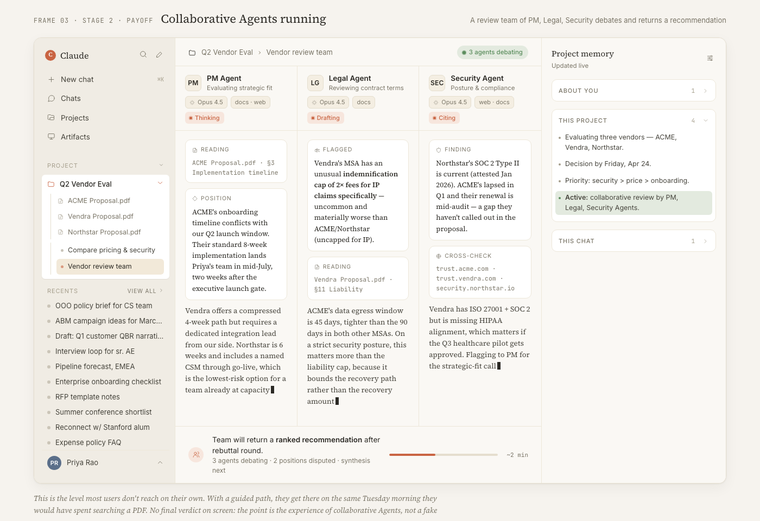
| C. Parallel and collaborative Agents | First-class support for parallel Agent runs (independent streams running at once) and templated collaborative teams (PM, designer, engineer working a shared problem). | Capability | Medium-high |
7. Recommendation: a three-part system, sequenced
Ship this as a staged system, not three independent features.
Stage 1: ship A. Highest impact per unit of cost. The primitives already exist; A is connective UX that surfaces the path to advanced use at the moment a user's behavior calls for it. Stage 1 also serves as the test: if A's prompts land (accept rate, time-to-first-Project, time-to-first parallel Agent run), that is signal the hypothesis holds.
Stage 2: ship B and C, conditional on Stage 1 signal. If users promote into Projects and try parallel Agents at meaningful rates, B and C turn that early behavior into durable depth. B makes a Project effortless to live in across Chat, Desktop, and Code, with memory that actually carries. C brings the advanced behavior forward: several workstreams running at once inside a single project, and role-based agent teams collaborating on shared problems.
Together, B and C let a single project become the home for all the flows around a piece of work (drafting, review, research, operations), well beyond what a single Chat thread can hold. Today that is not the experience. Working across Chat and Code, memory does not carry between them, so every surface switch costs context and restarts the user on setup. B closes that gap and C puts the advanced flows on top of it. The mockups below show what the Stage 1 surface and the Stage 2 payoff look like end to end.
8. Success metrics
- North star: DAU of Projects and parallel / collaborative Agent runs.
- Input: promotion impressions, accept rate, time-to-first-Project, time-to-first parallel Agent run, time-to-first collaborative Agent run.
- Outcome: 30-day retention lift, tier upgrade rate, API account linkage rate for Pro users running parallel or collaborative Agents.
- Guardrail: promotion dismiss rate, Chat satisfaction.
9. Risks and open questions
- Promotion fatigue. Frequency budgets and dismiss-and-remember at chat and account level.
- Power-user sensitivity. Account-level opt-out.
- Memory privacy. Opt-in, visible, editable, deletable.
- API surface translation. How A surfaces in Console and Workbench is an open design question.
- Validation research on the hypothesis itself is a prerequisite to Stage 2 commitment.
Four frames showing the staged system in use. Persona: Priya, BD lead at a 200-person SaaS company, prepping a Q2 vendor decision for Friday.
Mockups built in Claude Design
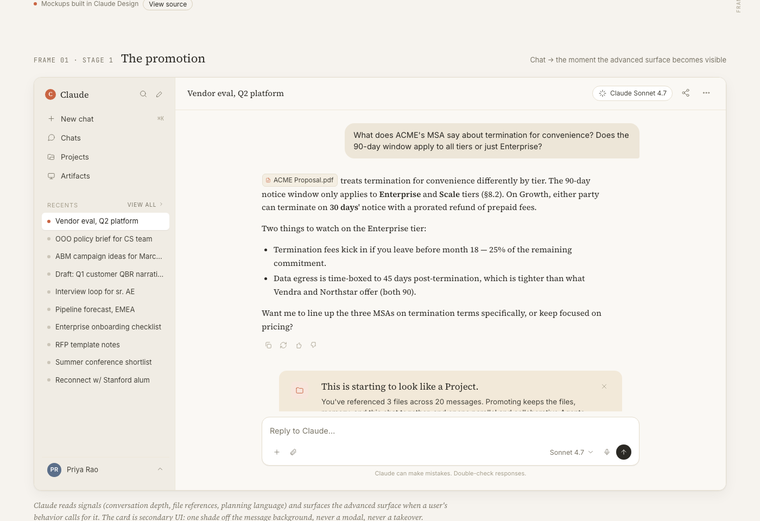
Claude reads signals (conversation depth, file references, planning language) and surfaces the advanced surface when a user's behavior calls for it. The card is secondary UI: one shade off the message background, never a modal, never a takeover.
Promotion is not a tax. The conversation continues uninterrupted, and what Claude already knew about Priya and this deal is now visible, portable, and hers to edit. The secondary card offers the next rung without demanding it.
This is the level most users don't reach on their own. With a guided path, they get there on the same Tuesday morning they would have spent searching a PDF. No final verdict on screen: the point is the experience of collaborative Agents, not a fake answer.
Four independent threads run under the same Project. No debate between them: each returns to Priya on its own schedule, and a downstream draft compiles when the upstream threads finish. The parallel mode to Frame 3's collaborative mode.